Batuhan Hazar Elibüyük
AI Engineer

January 20, 2026
How Mindbricks AI Transforms Your Ideas into Production-Ready Architectural Design
Introduction
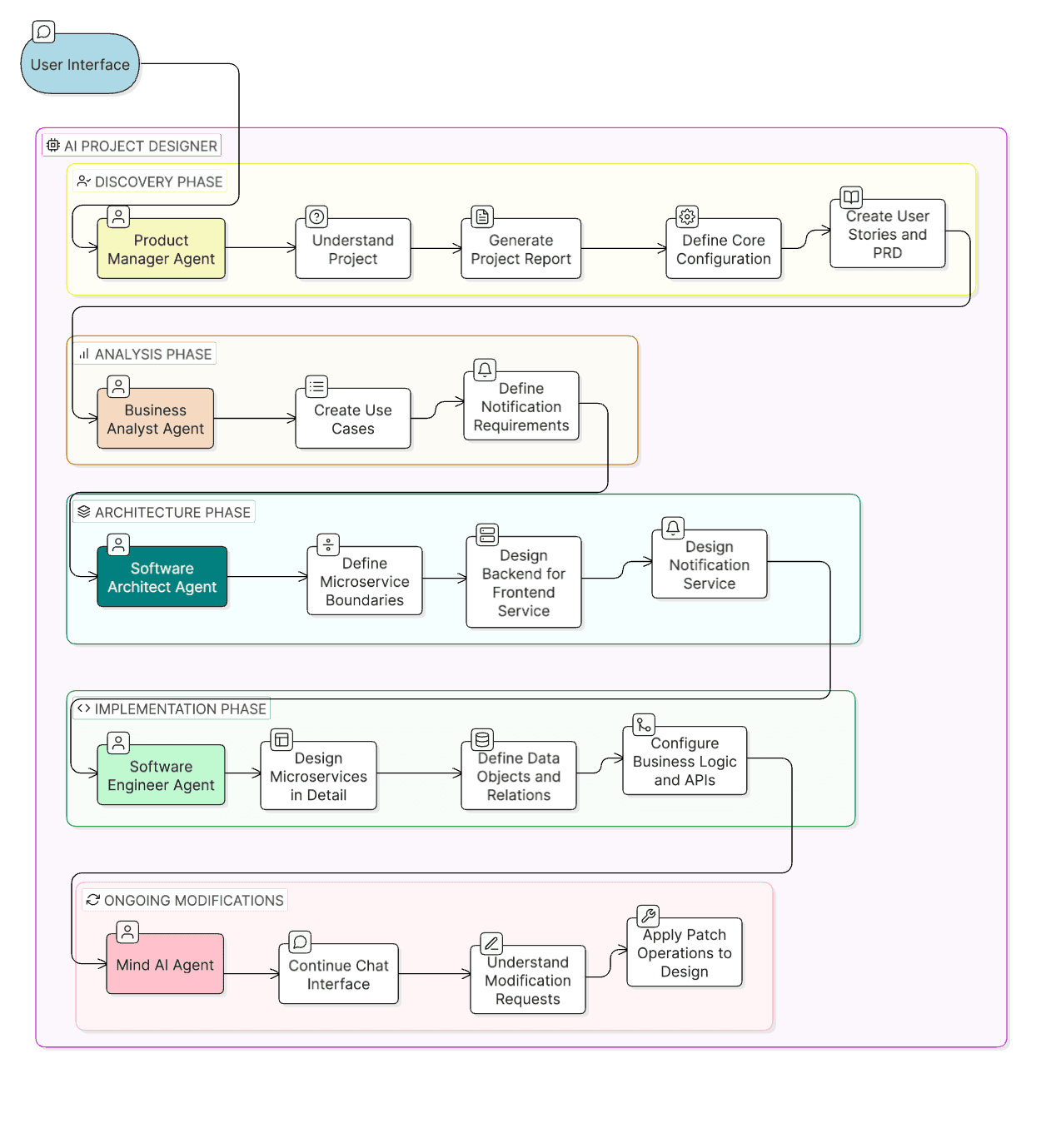
Agent ADA is the unified AI assistant powering Mindbricks' project design experience. Although users interact with what they perceive to be a single intelligent assistant, the reality under the hood involves ADA orchestrating several specialized AI agents. Each of these agents possesses a distinct area of expertise, working in tandem to transform natural language project descriptions into fully structured and production-ready backend architecture.
This document explains what happens behind the scenes when you chat with ADA: how your project ideas flow through different AI "personas," how they collaborate to understand requirements, and how everything culminates in a complete project configuration that Mindbricks' code generation engine uses to produce real, deployable microservices.
Phase 1: Discovery and the Product Manager
The design process starts the second a user begins describing a project idea. During this initial stage, the Product Manager agent takes the lead as the primary point of contact.
Conversational Discovery
You should treat the Product Manager as a seasoned consultant who knows precisely which questions to ask. As you talk through your project, the agent drives a natural dialogue to pull out the essential data needed for your backend architecture. It asks specific questions about your purpose, user base, and requirements while digging into the areas that need more detail. The agent identifies nuances like authentication needs, user roles, and business logic. It is programmed to recognize the exact moment it has enough information to move forward. The system keeps a complete record of this conversation history, and that log serves as the baseline for every step that follows.
From Conversation to Structure
After the discovery phase ends, the system turns that unstructured chat into organized outputs to guide the design journey.
The first result is a Project Report. This document summarizes the project purpose, target audience, features, and requirements. It acts as a master reference for every other agent in the workflow.
Next, the system generates the Core Project Configuration. Using insights from your conversation, the agent makes fundamental architectural choices. This includes deciding on authentication needs, choosing between single tenant or multi tenant setups, and defining name formats. It also outlines role based access controls, custom properties for users or tenants, and any necessary verification steps for email or mobile.
The system then extracts User Stories in a clear, structured format. Each story follows the standard template of as a user type, I want to perform an action, so that I get a benefit. These are organized by user type and feature area. Every story gets a unique ID like US01 or US02 to ensure full traceability.
To wrap up the phase, a formal Product Requirements Document brings everything together. This includes the project goals, user needs, feature lists, technical constraints, and success criteria.
Phase 2: Analysis - The Business Analyst
With requirements documented, the Business Analyst steps in to translate high-level stories into actionable specifications. This phase bridges the gap between what users want and how the system will actually implement those desires.
Use Case Creation
Business Analyst scrutinizes every user story to generate precise use cases that eliminate any uncertainty about how the system operates. The AI identifies the specific actor involved in the interaction whether that is a customer, an administrator, or the system itself and defines the exact goal the process must achieve. It sets the preconditions that must be true before the sequence begins and then builds out the main flow to describe the logic in a clear numbered order. The AI develops alternative flows to handle edge cases while keeping specific references that point back to the original user stories. Every use case receives a unique identifier such as UC01 or UC02 to ensure that every decision remains searchable and traceable throughout the design process.
Phase 3: Architecture - The Software Architect
The Software Architect agent establishes the critical system structure before any detailed design work begins. This stage bridges high level conceptual thinking with practical implementation constraints to ensure a stable foundation.
Microservice Boundary Definition
The architect analyzes use cases and domain requirements to determine the most effective way to decompose the system into independent and manageable pieces. Service decomposition requires the AI to decide how to split the system into microservices by grouping related domain concepts and drawing clear service boundaries. These structural choices directly impact long term scalability and how engineering teams organize around the codebase.
Responsibility assignment defines exactly what each service does and identifies which data objects a specific service owns. This process clarifies how services interact with one another to prevent the tight coupling and confusion that often break poorly designed systems. Data object identification then maps out core entities and their properties while establishing the initial relationships between them.
In an e-commerce context the architect might divide the project into three distinct areas. A Product Catalog Service manages products and inventory while an Order Management Service handles fulfillment and a Customer Service maintains profiles and preferences. Every microservice definition maintains a direct link back to the use cases it supports to ensure every architectural decision has a clear and documented justification.
Phase 4: Implementation - The Software Engineer
The Software Engineer agent manages the detailed design of each microservice by transforming architectural blueprints into comprehensive configurations ready for code generation.
Detailed Microservice Design
The engineer produces exhaustive specifications for every microservice established by the architect to cover every facet of the implementation. Data Object Design ensures that every entity has complete property definitions. This involves specifying data types such as strings or integers along with validation rules for required fields and uniqueness constraints. The agent also determines default values and indexing strategies to optimize search performance while setting access control levels for public or private data.
Relationship Configuration defines the ways data objects connect through foreign key relationships and referential integrity rules like cascade deletes. It also manages cross service relationships that the BFF layer handles to keep the system cohesive. API Configuration then dictates the specifics for every CRUD operation and custom endpoint. This includes authentication requirements and authorization rules based on user roles as well as input parameters and custom response formatting.
Business Logic Actions utilize a wide range of supported action types to execute the core functions of the application. The engineer configures these actions to fetch related data or call external services while validating specific conditions and transforming data. These logic flows also trigger notifications and integrate with external APIs to ensure the microservice fulfills its functional requirements within the larger ecosystem.
Automatic Validation and Correction
Quality assurance is built into the design process. After designing each microservice the system performs comprehensive integrity checks. Relation validation verifies all references point to existing objects while cross service consistency checks ensure services reference each other correctly. When issues are found an AI assisted correction system suggests fixes and confident corrections are applied automatically. All validation results and corrections are logged for complete transparency.
Ongoing Modifications - Mind AI
Once the initial design is complete, the conversation doesn't end. Users continue chatting in the same window, and now Mind AI handles these ongoing interactions.
Intent Understanding
Every message is analyzed to determine exactly what the user wants. The system recognizes several distinct intent types: project modification requests where users want to change something (like "Add a description field to products"), read-only help where users ask questions about how things work, general chat for casual conversation, and situations that need clarification when requests are too vague to act upon.
The Genesis Connection
The pattern schema originates from Genesis, Mindbricks' code generation engine. Genesis knows exactly what configurations it needs to produce Node.js microservices. This schema serves as a contract:
AI agents produce configurations that follow the schema
Genesis consumes those configurations to generate code
Validation ensures the AI output is always Genesis-compatible
When AI agents generate project configurations, their outputs are automatically validated against this schema. If the AI produces something invalid, the system catches it before it ever reaches Genesis.
The Project Configuration Structure
Every project ultimately becomes a structured configuration with these major sections:
Section | Purpose |
Project Settings | Name, description, integrations, custom variables |
Authentication | Login methods, roles, permissions, user/tenant properties |
BFF Service | Data views that aggregate information for frontends |
Notification Service | Email, SMS, push notification configurations |
Services | The actual microservices with their data and logic |
Each microservice section contains:
Service Settings: Name, database type, login requirements
Data Objects: Entities with properties, relations, and access rules
Business Logic: APIs with custom actions, validations, and workflows
Library: Custom functions, templates, and edge controllers
This structured approach is what allows Genesis to generate millions of lines of consistent, production-ready code.